
Chicken Math, Explained
by Meghan H
Published June 25, 2018
Whether you are new to chicken keeping or a seasoned veteran, chances are you have heard the term chicken math. Chances are even higher than you have calculated some of your own chicken math, even if you were not aware of it! So what is meant by chicken math and how did this term become a common term within the chicken-keeping world? In its simplest terms, chicken math is the addition to your flock in quantities and maybe even other species that are beyond what you originally planned.

They’re so little and cute at first, but then we realize that chicks grow fast and need more space. These little ladies spent the winter growing out in a greenhouse.
How The Math Works
Perhaps you planned to have 6 birds but now somehow have 14, 22, 30. Or maybe you planned to only have chickens but have mastered advanced chicken math and now have ducks, rabbits, and a cow! My personal theory on chicken math is not only are chickens a lot of fun to keep, they are relatively low maintenance, and do not take up much space, so it becomes very easy to say “What difference would a few more make?” Chicken math can be perpetuated in many different ways; perhaps a broody hen hatched some eggs, you incubated eggs yourself, Meyer Hatchery had a sale, or you were gifted some birds. Throughout your chicken-keeping adventures, your knowledge and experience will grow, and chances are very high that the quantity of your flock will also grow.
Here are some examples of my own chicken math
- First flock of 14 chickens + 6 chicks = 2 goats
- 32 chickens + 1 guard dog = 2 bantams (but bantams only equal ½ a chicken)
- 50 (ish) chickens + 12 sale chicks = too many brown eggs
- 21 chicks (needed some more color in the egg basket) = 10 broilers
- 12 adolescent chicks (but they were a gift so they don’t actually count towards a total) = not knowing how many chickens I have
There is no exact rhyme or reason to chicken math, but that is part of its beauty! How has your flock grown in unexpected ways? Please share your own chicken math in the comments!
Related Posts You Might Like

Farmstead Brooding: The Extreme Edition
In this Coop Tour, Amanda and Marie from the Meyer Hatchery CSR Remote Team, shows us Marie’s Extreme Edition Farmstead Brooding inside a high tunnel.
Chicken Keeping on a Budget
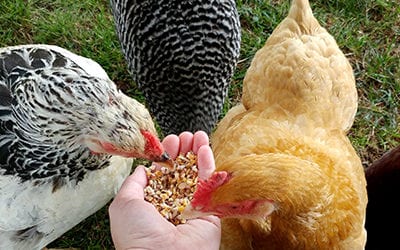
It’s no secret that raising your chickens, whether for eggs, meat or both, can be an expensive undertaking. Some of us may have started our chicken-keeping adventure with the thought of saving money on grocery store eggs and/or meat but quickly figured out it is hard to compete with the mass production prices. You may be like me and hesitate to calculate how much you have spent on your flock, for fear of sticker shock!
Auto-sexing versus Sex-linked Chicken Breeds
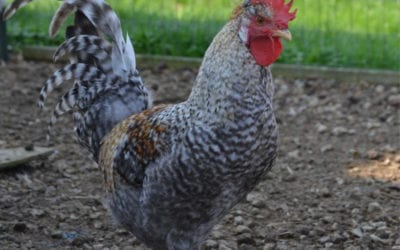
The desire to have as many female chicks as possible is so great that there are specific breeds of chickens that have been bred so that the flock owner or hatchery can determine the gender of day-old chicks more easily. Breeds that are either autosexing breeds or sex-linked hybrid breeds produce chicks that are slightly different colors between the genders at hatch.
I was only going to start with 12 chickens which my husband thought was overboard. In the past two months, I have ordered 40 chickens and 3 ducks, all from Meyer Hatchery. Too bad you guys don’t sell goats! Those are next. (But maybe a few more chicks first — I have 15 in my cart ready for my next year’s additions).
My husband thinks it has exceeded basic chicken math and has graduated to “fowlgebra”.
Bwahahah! That’s awesome… fowlgebra. Thanks for reading and posting! So happy you are enjoying your chickens 🙂
If I end up making a Fowlgebra shirt as I keep threatening, I’ll definitely send you guys some. ♡
Love all my girls so much! They’re so much fun.
We have thirty plus chickens just ordered thirty two more, have twelve goats and well over fifty Koi. I would say that we’re into trighenomics already.
Sounds you are well advanced in your calculations! Thank you for reading 🙂
Don’t you mean their cluckuations? Hahaha!
“Trighenomics”! You all are so creative in your chicken math “term-hen-ology”!
So that’s what happened; I went from chicken math to fowlgebra to trighenomics. I don’t need an intervention!!
Started small but chickens are addictive. As the Meyer sign put it – Ckickens are like potato chips, you can’t have just one. I have 70 plus out in the barn (20 acres free range) 44 chiclets and picking up 6 more chiclets on Tuesday. I tell people that I have the UN of chickens from all over Europe and the world. I sell my eggs like any good pusher – the first dozen is free!! If people don’t come back pleading for eggs then it is only because they don’t taste the difference. Yes there really are people who can’t tell the difference.
I wasn’t sure about getting chickens until I did all my research. Said I’ll only start with 6 ( actually when I went for my first chicken “nuggets” I said 4, but the gal said go for 6…..ok my arm was twisted haha). I got those 6 and they’re now 15 wks old. In the meantime I decided I wanted more of one breed and some of another breed, so naturally I ordered from Myers 8 more! There’s other breeds I want and already have started my cart with some for around October. Math has never been my strong suit anyway.
You sound like a pro at (chicken) math! And before you know it, you need a bigger coop!
Or calculations CLUCKUATIONS
I started with 6 (because when you buy them from a feed store in KY you are REQUIRED to purchase at least 6). The next spring I wanted hens that produce COLORFUL eggs, so I ordered 5 more. One of the “pullets” was a “cockerel” so I ordered a replacement, but had to order the required shipment amount, so I added 5 more. 2 were DOA (not Meyer Hatchery, from a different place I will no longer order from) and 1 died the next day. Then I went to another feed store and saw baby chicks…..bought 8 of them! Re-homed 2 roosters, a hen died from being r***d by one of those roosters! 1 died from a neighbors dog attack, and one pullet “came up missing”. One of my mature hens went broody so I ordered 17 hatching eggs from Meyer Hatchery (you guys are the BEST!!) and TODAY is HATCH DAY!! Just went out to look and she currently has one baby under her and the rest are ready to come out!!!!!!! I’m sooooo excited!! Thank you Meyer Hatchery!!! I’m extending my coop/pen and I don’t care if I end up with 100 chickens!!!! I will be ordering more eggs from you!
Aw congrats on being a new chick grandma! It sounds like you might be well on your way 100+ chickens and we are happy to enable your chicken math!
Yes, but chicken math also works the other way! Over the course of the year, predators make their own subtractions!
It’s a sad truth, unfortunately.
9 chicks = perfect egg color basket
+ 7 more = we are going to sell eggs now
+ 3 lavender orphingtions = if I have a rainbow of eggs I also should have a rainbow of hens.
I couldn’t agree more!
I started with 3 chickens and how have 13 hens, a rooster, 3 Guinea fowl, 3 rabbits, 2 goats and 3 sheep.
I also sold my house to move out to the country.
My problem comes from having my birds housed next to the old zoo. People dump their unwanted birds at the zoo, so then they show up at my fence, and beg to be rescued. My rescues are super sweet, and don’t have the entitlement issues my hand raised girls have. There are definitely cliques in my flock, between the hand raised and the rescues. I have gotten both ducks and chickens this way. Plus people know I rescue, and will occasionally just throw their birds in my pen. Small town problems. Lol. Needless to say, I don’t always have a true count…I know what I think I have…which is 96, plus the two wild mallard drakes that have been flying in every day for snacks and to make love eyes at my she ducks.
HI Jessica. That is a bit of a problem when it comes to chicken math!
I was accidentally placed in an AP Trighenomics class!
8 hens+1 raccoon-2 hens= 2 pregnant goats
Trighenomics for sure!
I ordered my first 8 chicks from the hatchery. They ended up giving me 9. I lost one to a hawk, so I purchased 5 silkies because they’re cute. I decided we needed to add a puppy into the mix. But then, I lost my original rooster to a predator and bought 2 more roosters but they gave me a third. So I had 15 chickens, but decided I could use a goat to help with maintaining my flower beds. I had 15 chickens, one puppy, one goat. Decided I need a few more chicken friends, so I bought 6 of every kind of egg layer the hatchery had, which left me with 21 chicks. Of course, they threw a few extra in. I ended up finding some cool breeds on Google, so I had to meet the minimum shipping requirement of 15 chicks. Also the hatchery didn’t have one of the chicks in stock, so I’m getting 6 more from the hatchery the same day the 15 will arrive. #chickenmath
Brittany, chicken math for sure! It sounds like you have a great group! Enjoy your new chicks, too!!
I think I went beyond normal chicken math. I by passed goats and cows and went from chickens to alpacas and llamas.
My wife and I are thinking about quail, and while I was musing about numbers yesterday she warned me of chicken math. “Quails are not chickens but chicken math still applies!” Luckily, we already know that I tend to go overboard and make things more complicated than necessary, so I am deliberately pointing this energy toward Planning and Research so we can figure out (as best as one can ahead of time, anyway) exactly how big a flock we want to aim for. Not saying this is going to guarantee it stays static! But at least having plans in place for when and how we want to add new members and remove old members will help, and help to curb my instincts to always be escalating.
Excellent idea! Best of luck with your quail adventure!